Dragon Tiger: How to Play
Dragon Tiger is a live dealer card game streamed from a studio, not a video slot. It simplifies traditional Baccarat into a fast-paced comparison between two hands: Dragon and Tiger. The game is known for its straightforward rules and rapid rounds, often concluding within 20 seconds.
This guide explains the core mechanics, betting options, and practical considerations for playing Dragon Tiger. It focuses on the live table format provided by studios like Evolution Gaming, detailing the available wagers, their respective payouts, and the associated return to player (RTP) percentages.
Basic Rules and Gameplay
Dragon Tiger is played with a standard deck of 52 cards. A live dealer draws one card for the Dragon position and one card for the Tiger position. The objective is to predict which hand will receive the higher-ranking card. Card ranks follow the standard order, with Ace being the lowest and King the highest. Suits are irrelevant for the main bet. If both cards are of equal rank, the result is a Tie.
The game proceeds in rapid rounds. Players place their bets on one of three main outcomes: Dragon, Tiger, or Tie. After betting time closes, the dealer reveals the two cards. Winning bets are paid according to the payout table. The game then immediately resets for the next round.
Step-by-Step Guide for Your First Session
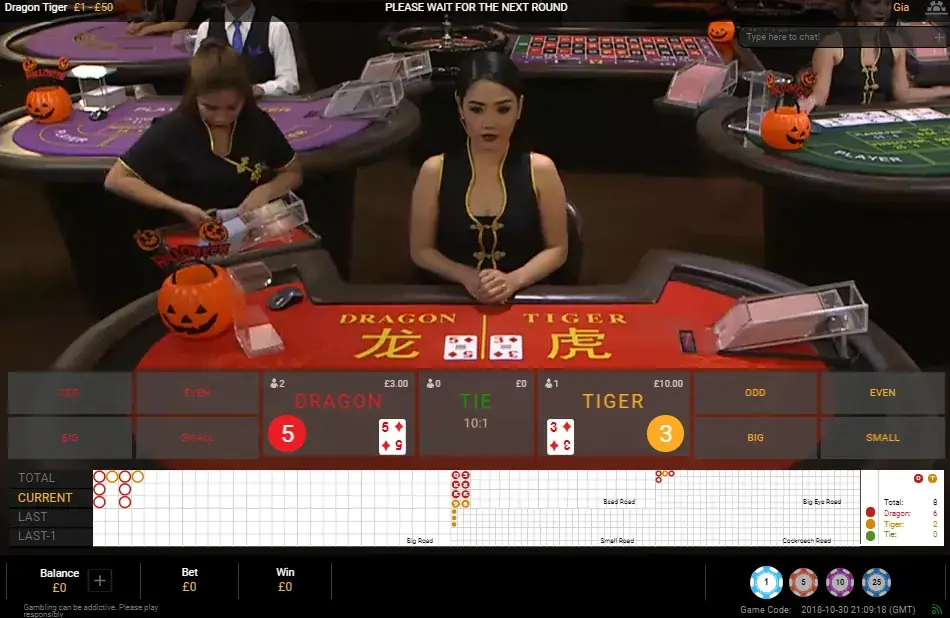
- Select a Dragon Tiger table. You will see a virtual betting layout and a video stream of the live dealer and game table.
- Familiarize yourself with the betting area. Chips are placed on marked zones for Dragon, Tiger, Tie, and any available side bets.
- Set your bet size. The minimum bet can be as low as $0.50, while the maximum can reach $25,000, depending on the table limits.
- Place your chip(s) on your chosen betting option before the countdown timer expires.
- Watch as the live dealer draws and reveals one card for the Dragon and one for the Tiger.
- If your bet matches the winning outcome, your winnings will be credited automatically. If you lose, your stake is collected.
- The next betting round begins shortly after. Manage your session by setting a bankroll limit before you start playing.
Betting Options and Payouts
The primary bets in Dragon Tiger are on which of the two cards will be higher. Side bets add additional wagering opportunities. The following table details the common bets and their payouts.
| Bet Type | Description | Payout |
|---|---|---|
| Dragon | Bet that the Dragon card is higher. | 1:1 |
| Tiger | Bet that the Tiger card is higher. | 1:1 |
| Tie | Bet that both cards are of equal rank. | 11:1 |
| Suited Tie | Bet that the Tie occurs with both cards of the same suit. | 50:1 |
The Dragon and Tiger bets offer the highest Return to Player (RTP), which is 96.27% by default. The Tie and Suited Tie bets have higher payouts but a significantly lower RTP, increasing the house edge. Side bets generally have a lower RTP than the main bets.
Game Features and Format
Dragon Tiger is a live table game. It is streamed from a professional studio with a real dealer managing the cards and the round. The visual design often incorporates Asian-themed aesthetics. The game has low volatility, meaning wins are frequent but typically smaller in size relative to the bet.
The maximum win multiplier in a standard round is 50:1, achieved by winning a Suited Tie bet. Rounds are very fast, with each game cycle lasting approximately 20 to 25 seconds from bet placement to resolution.
There are no bonus rounds, free spins, or wild symbols as found in slot machines. The game's features are its simple betting structure and the live dealer presentation. Some game variants may include additional side bets like Big/Small or Odd/Even, which predict the numerical value of the drawn cards.
House Edge and Player Return Analysis
The Return to Player (RTP) percentage is a critical metric for understanding the long-term theoretical payout of a casino game. For Evolution Gaming's Dragon Tiger, the primary RTP is 96.27%. This figure represents the default mathematical return from the developer, though it is important to note that individual online operators may choose to run a version with a lower RTP. An RTP of 96.27% implies a house edge of 3.73% on the main Dragon and Tiger bets. This edge is relatively low compared to many other casino table games, which contributes to the game's appeal for players seeking favorable odds in a fast-paced environment.
Not all betting options within Dragon Tiger carry the same RTP. The 96.27% return applies specifically to the core Dragon and Tiger wagers, which pay out at 1:1. Side bets, while offering higher potential payouts, come with a significantly higher house advantage. The Tie bet, paying 11:1, and the Suited Tie bet, paying 50:1, have much lower RTPs. This creates a strategic consideration for players. Sticking to the main Dragon or Tiger bets offers the best statistical chance of preserving one's bankroll over an extended session, while the side bets function as high-variance, lower-probability propositions.
The game's volatility is low, which aligns with its straightforward, single-card-comparison mechanic. Low volatility suggests that wins and losses tend to occur in a more frequent and regular pattern, avoiding the long dry spells or massive single wins associated with high-volatility games. This characteristic makes Dragon Tiger predictable in its pacing, suitable for players who prefer a steady stream of smaller outcomes. The maximum win potential, however, can reach 50:1 on a Suited Tie bet, introducing a high-payout possibility within an otherwise low-volatility framework.
Understanding these mathematical underpinnings is essential for informed play. The combination of a 96.27% RTP on primary bets and low overall volatility positions Dragon Tiger as a game where the house's statistical advantage is clear but not excessively punitive. This structure supports extended gameplay sessions, as the theoretical rate of bankroll depletion is slower than in games with a higher house edge. Players should be aware that the enticing payouts of the Tie and Suited Tie bets are offset by their reduced RTP, making them occasional gambles rather than the foundation of a sustainable strategy.
Key Terms Glossary
- Dragon/Tiger Bet: A wager on which of the two dealt cards will have the higher rank. Pays 1:1.
- Tie Bet: A wager that the Dragon and Tiger cards will be of equal rank. Pays 11:1.
- Suited Tie: A side bet that the Tie will occur with both cards belonging to the same suit. Pays 50:1.
- RTP (Return to Player): The theoretical percentage of all wagered money a game will pay back to players over time. The default RTP for Dragon/Tiger bets is 96.27%.
- Live Dealer: A real human dealer who manages the game, streamed live from a studio to player devices.
- Volatility: A measure of risk and frequency of payouts. Dragon Tiger has low volatility.
Dragon Tiger: questions and answers
What is the main objective in Dragon Tiger?
The objective is to predict which of two dealt cards, one for the Dragon and one for the Tiger, will be higher in rank. You bet on Dragon, Tiger, or a Tie.
What is the RTP for Dragon Tiger?
The main Dragon and Tiger bets have a default RTP of 96.27%. The RTP for Tie and side bets is lower. Operators may sometimes run tables with a lower RTP version.
What is the maximum payout in Dragon Tiger?
The highest standard payout is 50:1 for a Suited Tie side bet, where the Tie occurs with both cards of the same suit.
Is Dragon Tiger a game of skill or chance?
Dragon Tiger is purely a game of chance. The outcome is determined by the random draw of two cards. No strategy can influence the result.
How fast are the game rounds?
Rounds are very fast. The entire cycle from placing a bet to seeing the result typically takes between 15 and 25 seconds.
Are there different versions of Dragon Tiger?
Yes. The core game is offered by multiple providers. Evolution Gaming's version is widely recognized. Some variants include additional side bets like Big/Small or Odd/Even.